4K60 Processing
SD, HD, Full HD and UHD formats are supported within the 600 MHz bandwidth envelope, including DCI 4096×2160 modes.
2160p60


A clear technical map of the HDfury Vertex — bandwidth, video processing, routing, EDID, HDCP, HDR metadata, audio extraction and system control.
Vertex is built around full-bandwidth HDMI 2.0-class processing. These are the figures that define what can pass through the signal path.
Grouped by function, so a customer can understand the device without having to decode a long manual.
SD, HD, Full HD and UHD formats are supported within the 600 MHz bandwidth envelope, including DCI 4096×2160 modes.
Two HDMI inputs and two HDMI outputs. Use Vertex as a matrix, splitter or switcher and apply independent output behavior.
Upscale, downscale, passthrough and bypass, plus chroma, color-space and color-depth conversion. Individual scaling rules can be set per output.
Choose a preloaded EDID, upload a custom EDID, use a fixed EDID or create an AutoMix EDID from connected displays.
Works with HDCP 1.x and 2.x sources/sinks and provides configurable HDCP handling per output for mixed-generation systems.
Inject and extract HDR and HDMI InfoFrame metadata in real time, including AVI InfoFrame and VSIF manipulation.
Passes HDMI audio formats through HDMI. Simultaneously extracts analog stereo or up to 5.1 digital audio through the 3.5 mm combo output.
Front-panel controls plus IR, USB and RS232. Optional GoBlue adds Bluetooth-based mobile control.
On-device and on-screen signal information helps expose the active HDMI format and troubleshoot the signal chain.
Select a control or connection to see what it does inside a real HDMI system. The diagram uses the actual Vertex product image and live programmed HUD elements.
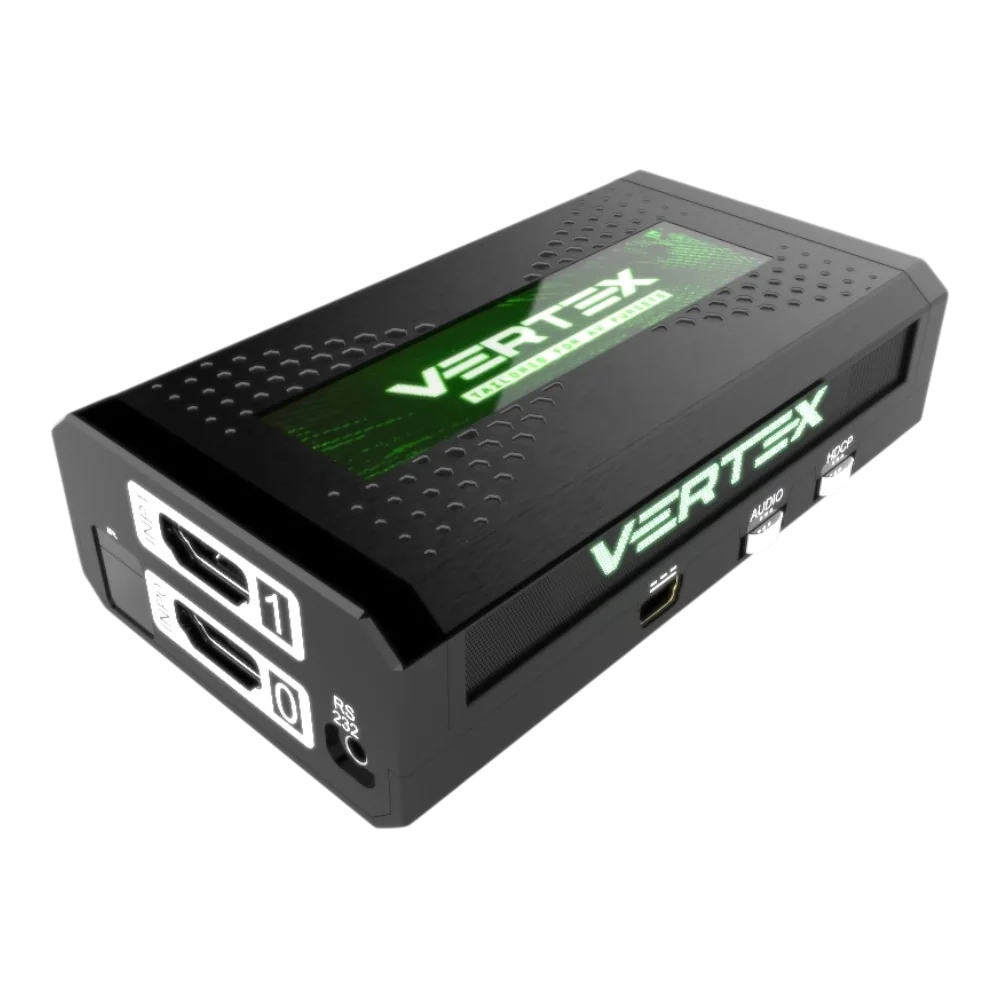
Connect up to two HDMI source devices. Vertex can select and route these inputs independently through its 2×2 matrix architecture.
OPEN RELATED GLOSSARY →Vertex sits between source and sink devices and can modify the handshake, routing and video format while the signal moves through the system.
A faster way to understand the specification sheet before opening the detailed database.
Up to 18 Gbps / 600 MHz, including 4K60 4:4:4 8-bit and 4:2:2 up to 12-bit examples.
Two HDMI inputs and two outputs for matrix, splitter and switcher workflows.
Preloaded EDIDs plus custom EDID, sniffing, editing and AutoMix tools.
Upscale, downscale, passthrough, chroma, color-space and color-depth processing.
HDR metadata, AVI InfoFrame, VSIF and Dolby Vision EDID/handshake workflows.
Front panel, IR, USB, RS232 and optional GoBlue mobile control.
The complete Vertex technical table, reorganized into six clear systems. Every specification opens its own glossary explanation.
18 Gbps / 600 MHz maximum signal class.
Compatible with HDMI versions 1.0 and upward, subject to the Vertex 600 MHz / 18 Gbps bandwidth limit.
4K60 RGB/YCbCr 4:4:4 8-bit and 4K60 4:2:2 up to 12-bit. The manual also lists 4K120 4:2:0 8-bit and 8K30 4:2:0 8-bit within 600 MHz.
SD, HD, Full HD and UHD formats within bandwidth, including 480i/p, 576p, 720p up to 120 Hz, 1080i/p, 1440p and 2160p up to 60 Hz.
Processing/scaling support includes DCI 4096×2160p within supported bandwidth.
Upscale, downscale, passthrough and bypass; chroma, color-space and color-depth conversion at 8, 10, 12 and 16-bit where applicable.
2 inputs / 2 outputs; matrix, splitter and switcher workflows.
100 EDID tables; custom upload; sink EDID sniff/save/edit/load; AutoMix; individual EDID per input.
Selectable/forceable capabilities include stereo, 5.1, 7.1, Native, BT.2020/xvYCC, HDR10+, HLG, Dolby Vision, 3D removal and YCbCr removal.
HDCP 1.x / 2.x source and sink interoperability with configurable output handling; HDCP 2.2 on the outputs: the manual says both outputs (p.11) and elsewhere only the top output (p.107).
Real-time HDR metadata injection/extraction plus AVI InfoFrame, VSIF and other InfoFrame manipulation.
Dolby Vision EDID/handshake workflows; Vertex can sniff the mandatory DV string from a compatible sink.
Lossless formats pass through HDMI without being compressed or downconverted by Vertex.
3.5 mm D/A combo jack: analog stereo or mini-TOSLINK digital audio up to 5.1 Dolby/DTS.
Front-panel push buttons, IR, USB and RS232; optional GoBlue for Bluetooth/mobile control.
Vertex GUI controls are available through RS232 commands for serial-based control systems.
CEC command management for compatible HDMI equipment.
Added latency is described as only a few pixel clocks — effectively negligible for normal use.
USB is used for power and firmware upgrades. The supplied Vertex power supply is required during operation.
2 HDMI inputs, 2 HDMI outputs, IR, RS232, USB, 3.5 mm analog mini jack and optical S/PDIF out.
3.12″ diagonal OLED, 256 × 64 pixels, 32 levels of green (manual; the HDfury product page says 16).
External 5 V / 2 A USB power supply. Power consumption under 2 W.
10 × 6 × 3 cm, 130 g. Black PVC / silver metal enclosure with green LED. The manual also gives the height as 0.8″.
Built-in equalization: 1080p up to 15 m in and 15 m out (30 m total); UHD up to 10 m.
PCM up to 192 kHz, IEC61937 compressed audio, DSD, DST, DTS, DTS-HD MA, Dolby TrueHD, DD+, HBR, DTS:X and Dolby Atmos over HDMI.
CE, FCC, RoHS and WEEE. Supports Deep Color, xvYCC and 3D stereoscopic pass-through.
600 MHz is the HDMI/TMDS signal-rate class, not a display refresh rate. Supported combinations depend on total bandwidth, resolution, frame rate, chroma and bit depth.
EXPLAIN 600 MHz →Every important technical term is explained in plain English. The existing deep-dive glossary pages are linked where available.
The maximum raw HDMI link-rate class handled by Vertex. Resolution, frame rate, chroma and bit depth all consume this bandwidth.
OPEN DEEP DIVE →The TMDS character-rate class associated with full-bandwidth HDMI 2.0 signalling. It is not the television refresh rate.
OPEN DEEP DIVE →Chroma subsampling formats. 4:4:4 preserves full color resolution; 4:2:2 reduces color data to lower bandwidth while retaining full luma detail.
OPEN VISUAL GUIDE →The number of bits used to describe each color component. Higher bit depth provides more tonal steps but requires more bandwidth.
OPEN VISUAL GUIDE →A routing system with two HDMI inputs and two HDMI outputs, allowing sources to be switched and distributed to displays.
OPEN DEEP DIVE →Display capability data sent back toward a source. It tells the source which resolutions, audio formats and video capabilities should be offered.
OPEN DEEP DIVE →Vertex can combine capabilities from connected sinks into a generated EDID, useful when two displays or an AVR/display combination have different capabilities.
OPEN VISUAL GUIDE →Digital content protection used over HDMI. Vertex manages interoperability between supported HDCP generations in mixed equipment chains.
Changing the video resolution so one output can be optimized for a different display or AVR while another follows a different rule.
OPEN DEEP DIVE →Information accompanying HDR video that describes how the signal should be interpreted. Vertex can inspect, inject and manipulate relevant InfoFrames.
Small HDMI data packets carrying information about video, audio and vendor-specific features. VSIF means Vendor Specific InfoFrame.
OPEN VISUAL GUIDE →The signalling method used by HDMI up through this generation. The 600 MHz figure describes the maximum TMDS character-rate class Vertex handles.
OPEN VISUAL GUIDE →An HDMI receiving device such as a television, projector, AVR or processor input.
OPEN VISUAL GUIDE →An HDMI transmitting device such as a media player, game console, set-top box or Blu-ray player.
OPEN VISUAL GUIDE →The signal is passed onward without changing its resolution. Other management functions can still apply depending on configuration.
Optical S/PDIF carried through a 3.5 mm optical connector. Vertex shares this connector with its analog stereo output.
OPEN VISUAL GUIDE →CD-R Nederland / HDfury · Postbus 274, 8070 AG Nunspeet · KvK 08073694 · VAT NL002139420B84